
The Things You Neglect While Building a Business Still Compound
What a week at a summer camp taught me about parts of life that don't show up on a task list, and why they matter.
Last week I told you about my week volunteering at a summer camp.
I was on the maintenance crew with my husband, and our job was straightforward:
Keep the property running, catch small issues before they turned into big ones…
Handle whatever needed handling so the kids could just enjoy camp without knowing any of it was happening behind the scenes.
Service is a rule of life in our family and I want my children to see us doing it rather than just hear us talk about it.
So we got to work.
We cleaned, checked things over, and dealt with the kind of ordinary maintenance jobs that are easy to overlook when everything seems fine.
Trouble had been building quietly
Then one of those ordinary jobs stopped feeling ordinary.
One day we discovered that an essential part of the camp's wastewater system wasn't working the way it should.
There hadn't been a dramatic event or a big warning sign. The system had simply drifted off course quietly, the way these things tend to, and trouble had been building without anyone noticing.
We caught it early enough to fix it.
Had it gone on much longer, the whole camp could have been dealing with something far bigger than a maintenance job.
[Can you imagine what that would have looked like?]
I kept coming back to that thought for the rest of the week.
A system can look completely fine right up until the consequences of neglect show up. So does a business, a marriage, and a body.
The early signs are almost always too small and too boring to take seriously:
A conversation you keep pushing to later,
An extended stretch of little to no sleep, or
That welcome sequence or onboarding flow you know is messy but keep working around anyway, months without any real time to stop and think.
Nothing falls apart on the day you overlook any one of those things, which is exactly why it's so easy to skip them again tomorrow.
Neglect compounds too
One book I keep coming back to is Darren Hardy's The Compound Effect.
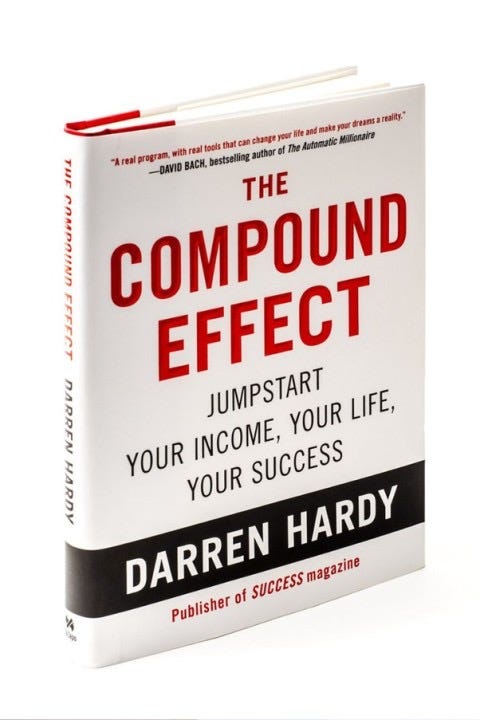
It’s idea is simple:
Small choices, repeated over time, add up to something much bigger than any single choice on its own.
We usually talk about that in the positive direction: read a few pages a day, save a little money consistently, practice a skill, make the call you've been avoiding, and eventually the results outgrow the size of the actions that produced them.
This camp experience made me think about the other direction just as clearly, because neglect compounds the same way.
A missed workout barely registers on its own, though months of barely moving eventually does.
Rushed conversations with your partner or child probably change nothing by themselves..
But treating "later" as your automatic answer every time they need you will change the relationship over time.
Sleep works the same way. One bad night is just a bad night. Weeks and months of little of it will eventually send in a bill you can't avoid paying.
The difficult part is that any single day's choice looks harmless in isolation, so we make it again the next day without really deciding to.
Business will consume every spare minute you give it
Building a business makes this especially easy to justify, because there's always something else to do.
One more email, one more post, one more page to refine, one more workflow to fix, one more thing to learn.
Give me an empty block of time and I will usually find a business task to fill it with.
I suspect most builders could say the same about themselves.
For short stretches, that intensity makes sense.
Launch weeks get busy, deadlines land, a client needs your full attention, and some seasons genuinely ask for more of you.
I don't think every day needs perfect balance measured down to the hour. That would be exhausting to maintain and probably impossible anyway.
The problem isn't temporary intensity. It's when that intensity quietly becomes the normal week instead of the exception.
If you want your business to support your family for years, not just this one, you need to keep showing up for the same family while building it all.
The same logic applies to everything else in my life.
Relationships need regular attention too

Healthy relationships need care on a regular basis, and most of that care doesn't look like much from the outside.
It's an intentional conversation after a long day,
Dinner without a screen between you
Listening when you'd rather go finish whatever you're working on,
Making time together before a problem forces you to make time.
None of it shows up on a task list, and that's fine. Some parts of life shouldn't have to justify themselves with visible output.
I have to remind myself of that regularly, because business rewards visible activity in a way relationships simply don't.
Relationships grow through a long series of small moments that nobody else ever sees, and they weaken through the same kind of quiet, unnoticed pattern.
Your wellbeing is easy to neglect until it isn't
Health and wellness is another place where neglect can stay quiet for a surprisingly long time.
You can skip movement today, eat whatever's easiest because you're busy, and push real rest to the weekend, then do it all again the next day.
Each individual choice is small enough to defend on its own. The pattern is a lot harder to defend once you zoom out and pay close attention.
You don’t need some extreme health routine to fix this.
You need enough care, applied often enough, that the body stops being the place every busy season dumps its cost onto.

Your inner life needs room too
There's also the part of life that never shows up on a dashboard: time to think, prayer or reflection if that's part of your world, silence, a walk you don't turn into content research, time with yourself when you aren't trying to optimize anything about yourself.
That last one is genuinely difficult for business owners, because we can turn almost anything into a project, even rest.
I can hit every goal on my list for the week and still notice I haven't been fully present anywhere in weeks. That pattern deserves attention long before it turns into a crisis.
Your business needs care too
The same lesson applies directly to the business itself. Growth is exciting in a way that care usually isn't.
Reviewing the data, refining a process, following up with leads, updating your offers, none of that gives you the same rush as building something new.
Some weeks, it deserves your attention anyway, and this is exactly where good systems earn their place.
They help you notice what needs attention before memory, urgency, and an overfull calendar make that decision for you.
I want AI to give me time back, not just more capacity to fill
I spend a lot of my time thinking about AI and systems, and there's an obvious business case for both.
They reduce repetitive work, speed up parts of a process, and hand you more capacity than you had before.
What I'm becoming far more interested in is what we actually do with that capacity once we have it, because I could take every minute AI gives me and feed it straight back into the business: more content, more research, more output.
I'd have used one of the most powerful technologies available today to make myself busier, which isn't a trade I want to make.
When AI or a good system saves me real time, I want some of those minutes returned to my actual life. Dinner with my family. An early morning walk. A conversation I've been putting off. Rest, and space to think.
I want technology to help me build with more focus while it leaves more room for the life the business is supposed to be supporting in the first place.
That feels a lot closer to intentional growth than simply working faster.
Pay attention before attention is demanded
By the end of camp week, I had a different view of maintenance work altogether.

The good days were quiet. The systems worked, and the 300+ campers got to just be at camp.
Care tends to look uneventful while it's working.
You give your marriage time, your wellbeing attention, your inner life some room, your home a bit of effort, and your business the ongoing care its systems need.
Then you do it again.
The effect of any single act is tiny, which is exactly the point Darren Hardy makes so well: small things compound, and so does everything we keep ignoring.
I'm in my business building era and I'll still have seasons when it takes more of me than usual. I just don't want "more of me" to quietly turn into "all of me" without my noticing.
So this week I'm sitting with a question worth asking yourself too: what in your life has been quietly asking for your attention?
You probably already know the answer. Pick one area, and give it a little care this week, before the neglect has more time to compound.
What will it be, my friend?
The Intentional Growth Letter explores business execution through AI and simple systems, alongside the human side of building a business, so you can grow intentionally in your work, your life, and the spaces between.
Here’s what a paid membership includes:
Come behind the build. Follow every stage, from idea to launch, as I build a portfolio of digital and physical products to $1M
See the decisions before the results. Learn from the strategy, AI workflows, systems, wins, setbacks, and lessons that shape each launch.
Borrow what works. Apply the ideas, frameworks, and experiments to your own business without having to figure everything out from scratch.
Ask questions along the way. Get direct access to the thinking behind the decisions and the opportunity to learn alongside me.
Enjoy member-only perks. Receive exclusive discounts on every new product I release.